
Statement on the Demolition of the White House’s East Wing
By Chris Moore, Executive Director
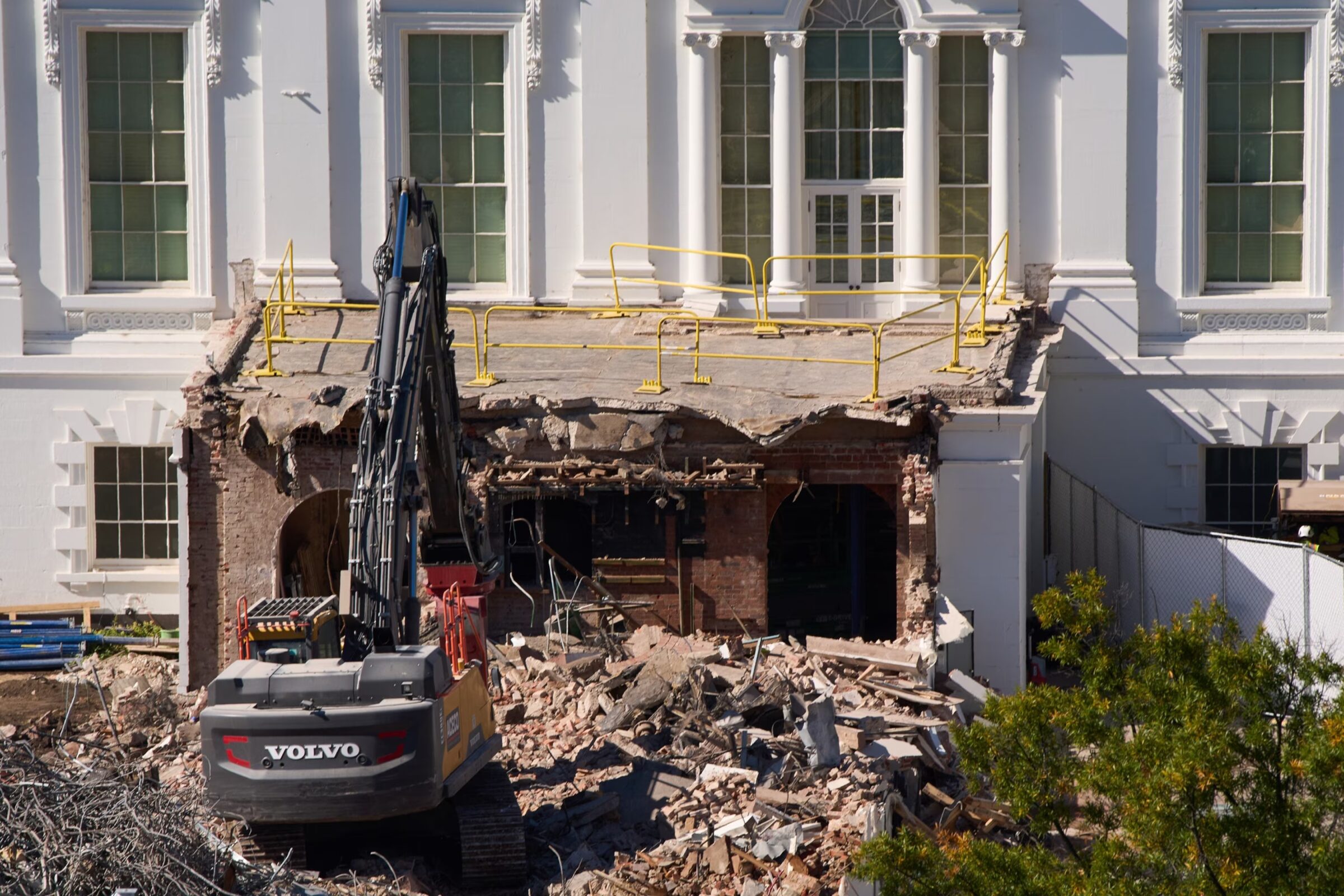
In talking about the October demolition of the East Wing of the White House, people generally have two reactions. The first is: “How could this possibly happen?” The simple fact is that, for the most part, preservation laws in our country do not protect historic buildings against demolition. The National Register of Historic Places is our list of federally designated historic buildings, structures, and landscapes, administered by the National Park Service with support from State Historic Preservation Offices. But National Register listing has always been honorary only. It does not convey protections on historic properties.
For federal undertakings (projects involving federal permits, funding, or other federal action), there is a process that reviews impacts to historic properties: Section 106. The purpose of Section 106 is to ensure the federal government considers historic resources in their project planning and design. But even this process is not prescriptive—it does not require historic properties be preserved, only that they be considered. (It’s also worth noting that even Section 106 is currently under scrutiny. In October, the U.S. Senate Committee on Energy and Natural Resources held a hearing to discuss whether Section 106 should be streamlined. Some elected officials seem to be implying that the process unnecessarily delays project implementation, which in our opinion it does not. With recent court decisions resulting in the weakening of other laws like the National Environmental Policy Act, we have concerns that Section 106 review will also undergo “streamlining,” thereby hampering efforts at the state level to balance resource protection with project delivery.) Moreover, the White House is just one of three federal buildings exempt from Section 106 (the other two are the U.S. Capitol Building and the U.S. Supreme Court Building). So, at the end of the day, the legal framework for historic preservation at the national level is simply not structured to save historic resources—not even the White House.
Which leads to the second reaction: “Why did this happen?” Perhaps this is an inherently political question. But the White House stands as an iconic symbol of American democracy—the People’s House, which presidents “rent” during their term in office. Whether or not there are laws to protect it is irrelevant. This simply should not have happened. Demolition of the East Wing is not a light-touch remodel of an outdated building feature—it is an erasure of history. The Washington Trust for Historic Preservation mourns the loss of our collective legacy represented by this action, which took place with no regard to the public interest. In the wake of this calamity, we will continue to fight for strengthening the framework for preserving historic resources at the national, state, and local levels. We hope you will join us.
Photo above: The demolition of the White House’s East Wing in Washington, D.C., in October, courtesy of ABC News.